Ayurvedic Body Types Explained: Why Your Ayurveda Constitution Is Not a Diagnosis, It’s a Holistic Blueprint Of Health
February 6, 2026
Coms 0
If you’ve been searching for Ayurvedic Body Type, you’re probably trying to translate a new idea into familiar words. In the West, “body type” often means shape, weight, or metabolism. In Ayurveda, it means something different.
An Ayurvedic Body Type or Ayurveda Constitution is not a diagnosis. It’s not a medical label. It’s closer to a baseline pattern, the way nature tends to express through your body and mind when life is normal.
And here’s the part many people find surprising. A lot of “new” wellness ideas are really old ideas with new packaging. Yoga got remixed into fitness. Breathwork got renamed, even though pranayama has been around for a long time. Ayurveda sits in that same category, a source system that keeps getting repackaged.
This article is meant to correct the Western misuse of “body type” and point you back to the original logic.
Ayurvedic Body Type vs Imbalance: Why Ayurveda Separates Baseline From Condition
When people learn their Ayurvedic Body Type, they often treat it like an identity. But Ayurveda separates baseline from imbalance for a reason.
Your baseline pattern is not “what’s wrong with you.” It’s the starting design. Imbalance is what happens when life pushes you away from that baseline.
This is where Ayurveda constitution matters as a supporting idea. Constitution points to what you were born with, while your current pattern shows what’s happening now. When people mix those up, they often chase fixes that do not match the real situation.
What “Ayurvedic Body Type” Really Means
In the West, body type often means ectomorph, mesomorph, endomorph. So it makes sense that people search Ayurvedic Body Type expecting the same kind of category.
But an Ayurvedic Body Type is not fate. It points to baseline tendencies. It suggests what your system is more likely to do under pressure, and what it is more likely to need when things get extreme.
Many learners try to map vata, pitta, kapha to ecto, meso, endo. The comparison can be a useful bridge, but it can also shrink Ayurveda into a mirror of modern fitness labels.
A better way to think about it is this. Western “morph types” focus heavily on outward build. Ayurveda focuses on the deeper pattern that shapes digestion, energy, mood, and recovery, even when two people look similar. Although, the morph types were derived from the Ayurvedic body types, as the outward physical definitions of the morph types match the Ayurvedic body types written about 5000 years ago.
So if you came here to learn about Ayurveda Constitution, the real upgrade is realizing that “body type” in Ayurveda is not just about your body. Let’s explore that further.
How Your Ayurvedic Body Type Is Established at Birth
People often ask how an Ayurvedic Body Type is set. Ayurveda describes birth constitution (prakriti birth blueprint) as a baseline pattern you arrive with, not something you “earn” later.
In simple terms, it is shaped by forces like genetics, environment, and timing. Even modern life shows how much timing matters. Two kids can grow up in the same home and still respond differently to the same foods, stress, or weather.
You may have one child who is quiet, does not socialize much, prefers being alone, talks mostly when talked to, and is picky about certain foods. Another child can be the opposite. They might be talkative, outgoing, social, and willing to eat almost anything without fuss.
When you observe their body type, you might notice a pattern. The child who prefers to be alone may look more slender, taller, and more bony. The outgoing child may look more average or well-built, with tanner skin and a strong appetite.
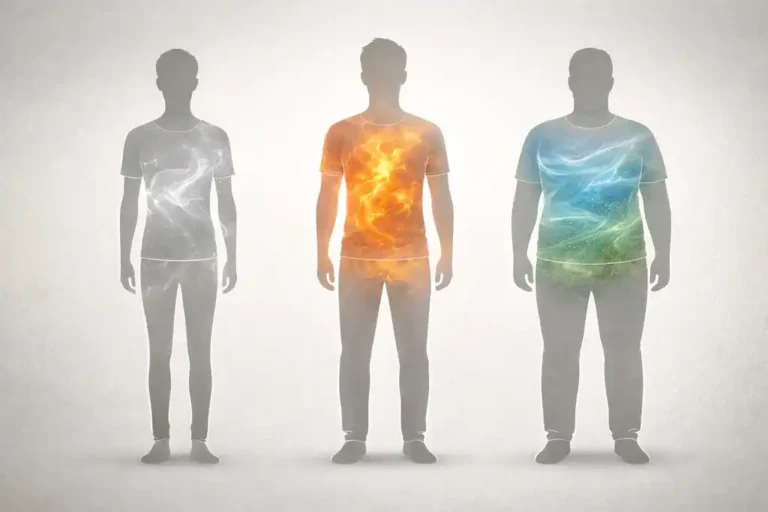
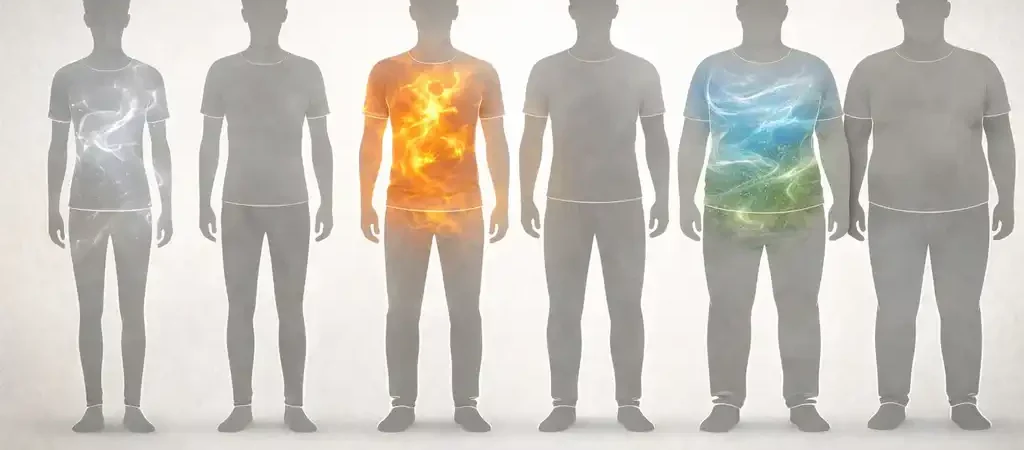
If you only used Western morph terms, you might say the quiet kid is an ectomorph and the outgoing kid is a mesomorph. In Ayurveda, that “ectomorph” pattern often lines up with a Vata body type, which includes more than physical build. It also considers mind, energy, appetite, social behavior, and other functional signs, not just the shape of the body. The outgoing “mesomorph” pattern can line up with a Pitta body type, which helps explain the social, talkative nature along with the strong appetite.
This is why Ayurveda uses the word doshas to describe the combined physical, energetic, functional, mental, and spiritual aspects of these body types. Ayurveda also ties these doshas to the nature’s elements, which then help explain why someone looks, acts and behaves a certain way, including, when their look, acts and behavior changes over time.
Learning the Ayurvedic Body Type interests many people, even fitness enthusiasts. But then they learn the wider application of body types in Ayurveda and realize that you were not meant to run on the exact same plan as everyone else, because you did not start with the exact same baseline or blueprint. This is where fitness enthusiasts, yoga lovers, and health conscious people start to make the bridge from the body type thinking, into learning about the body-mind-spirit connection for a holistic view of their being.
Why Two People With the Same Ayurvedic Body Type Can Differ
Here’s where Ayurvedic Body Type becomes practical without turning into a checklist. Two people can share a similar baseline and still look totally different in real life.
Lifestyle and choices shape expression. Travel changes you. Climate changes you. Work pace changes you. Sleep patterns change you. Stress changes you.
So the question becomes less “What is my Ayurvedic Body Type?” and more “How is my baseline being expressed right now?”
This also explains why wellness trends can feel confusing. One person tries a high-protein diet and feels strong. Another feels heavy and dull. One person lives on raw salads and feels clear. Another feels bloated and restless. If you only follow the trend, you may miss the pattern underneath.
And that’s where Ayurveda quietly challenges one-size nutrition systems. Not because those systems are always wrong, but because they assume the same inputs will create the same outputs in every body.
Your Ayurvedic Body Type is not a label. It’s a pattern.
Learn how Ayurvedic Body Type works and why Ayurveda constitution explains why the same food, supplement, or routine can help one person and aggravate another.
The Risk of Treating Your Ayurvedic Body Type Like a Label
When people discover their Ayurvedic Body Type (usually by doing a dosha analysis), they often want certainty. Labels feel like certainty.
But labels can create self-mismanagement. Someone may decide, “I’m kapha,” and blame everything on kapha. Or decide, “I’m vata,” and treat every discomfort as a vata problem.
The bigger risk is getting locked into a fixed identity while your life is constantly shifting your current state. That’s why an Ayurvedic Body Type is best understood as a baseline pattern, not a permanent box.
This is also why generic food rules fail so often. A kapha-leaning person pushing heavy, dense foods can feel more sluggish. A vata-leaning person living on cold raw salads can feel more scattered and dry. The twist is that if they swapped approaches, both might feel relief. Not because one food is “good” or “bad,” but because the pattern matters.
The point here is not to hand you a regimen. It’s to raise the right question. What works for one person can aggravate another, and the reason is not willpower. It’s pattern.
Why an Ayurvedic Body Type Assessment Matters More Than Articles
Articles can point you toward the logic of an Ayurvedic Body Type, but they can’t fully see you. They can’t watch your real-life patterns repeat across seasons, stress cycles, and routines.
That’s why proper assessment matters. Not as a gatekeeping thing, but as a reality check. Your baseline pattern and your current pattern can look similar on the surface and still need different thinking underneath.
If you want a clean foundation without overwhelm, our Ayurveda Doshas course is free and teaches the principles behind an Ayurvedic Body Type, so “body type” stops feeling like a random label and starts feeling like a usable concept.
Our Elemental Ayurveda course goes further into how your Ayurvedic Body Type and Ayurveda constitution show up in digestion, energy, mood, and recovery, and why foods, supplements, and lifestyle choices can work so differently from one person to another.
Becoming aware of your body starts with not only understanding the physical body changes, but how your mind, digestion, emotions, metabolism, and energy collectively change along with your physical. When you start tracking this shift, this is when you shift from ‘body type’ thinking to the Ayurveda doshas thinking. And how does Ayurveda track these collective shifts? This is what we address in our core Ayurveda courses.
FAQs: Ayurvedic Body Types Explained: Why Your Constitution Is Not a Diagnosis
What is an Ayurvedic Body Type?
An Ayurvedic Body Type is a baseline pattern in Ayurveda. It points to tendencies in how your system runs, not a medical diagnosis or a fixed identity.
Is Ayurveda constitution the same as an Ayurvedic Body Type?
They’re closely related. Ayurveda constitution usually refers to your birth baseline, while your Ayurvedic Body Type is the way people commonly describe that baseline pattern in simple terms.
Why does Ayurveda separate constitution from imbalance?
Because your baseline is not the same as your current condition. Ayurveda separates identity from imbalance so you don’t mistake a temporary pattern for “who you are.”
How is an Ayurvedic Body Type established at birth?
Ayurveda describes it as shaped by factors like genetics, environment, and timing. It’s the starting pattern you arrive with, not something you earn later.
Why can two people with the same Ayurvedic Body Type still feel different?
Because lifestyle, stress, seasons, sleep, and habits can change how the same baseline pattern expresses in real life.
How do Western body types compare to Ayurvedic Body Type?
Western morph types focus mostly on physical build. An Ayurvedic Body Type also considers functional patterns like appetite, energy, mood, and recovery, not just body shape.
Why do generic diets and standard food rules fail for so many people?
Because what helps one body can aggravate another. Ayurveda constitution is one way to explain why the same food, supplement, or routine can create different outcomes.
Why does assessment matter more than articles?
Articles can explain the concept, but they can’t track your real patterns across seasons and stress. Assessment helps separate baseline constitution from what’s happening right now.
Dr. Amit K. Gupta, MD is a Harvard- and Boston University–trained physician dedicated to bridging modern clinical medicine with the ancient wisdom of Ayurveda. He founded CureNatural to make Ayurveda clear, personalized, and credible. His work focuses on digestion, daily routine (dinacharya), and metabolic balance—using practical food and lifestyle guidance you can actually follow.
Over more than 25 years in health promotion, he received the U.S. DHHS Secretary’s Award for innovations in disease prevention and contributed patented work that helped lay the foundation for Health Savings Accounts (HSAs).
Medical Disclaimer: This content is for educational purposes only and is not medical advice. Reading this page does not create a doctor–patient relationship. Herbs and traditional Ayurvedic remedies discussed here are generally regulated in the U.S. as dietary supplements and are not evaluated by the FDA to diagnose, treat, cure, or prevent disease. If you have a medical condition, take prescription medications, are pregnant or breastfeeding, or are managing a chronic illness, consult a licensed clinician before using herbs/supplements or making health changes. For emergencies, call 911. Read the full disclaimer.
About the author:Dr. Amit K. Gupta, MD is a Harvard- and Boston University–trained physician and founder of CureNatural, focused on digestion, daily routine (dinacharya), and metabolic balance. View full bio.


 Google