

What Is a Holistic Healer? A Practical Guide to Understanding Holistic Medicine for Beginners
If you’re drawn to becoming a holistic healer, you’re probably seeking more than symptom relief — you want to support lasting well-being through natural, personalized methods. Holistic medicine for beginners starts with understanding all the different paths that exist for holistic health practitioner training.
Today, the word “holistic” is often used interchangeably with “natural,” but they’re not the same. Not everything natural is holistic, and not everything holistic is fully natural. Holistic medicine means treating the whole person — body, mind, and spirit — not just isolated symptoms. For example, if someone treats a headache with a natural oil without addressing stress, digestion, or sleep, the approach may be natural, but not truly holistic. Likewise, if you’re a doctor, and you have a patient who is on five pharmaceutical medications, but you supported that patient with nutrition, some supplements, along with some physical therapies, you certainly became “more holistic” but not everything was natural.
This is where Ayurveda offers a unique advantage. It’s not about choosing between holistic vs. functional medicine — Ayurveda combines both. It is deeply holistic, addressing mind-body-spirit through body type, energetics, and lifestyle. And it’s functional, going straight to the root cause through digestion, metabolism, detoxification, and vitality-building.
Whether you’re a licensed provider or just starting your healing path, Ayurveda forms a complete foundation for holistic health practitioner training. It can be used to support modern care or stand alone as a natural healing system. For any aspiring holistic healer, it’s the most comprehensive place to begin.
This article is for people curious about:
The difference between holistic vs. functional medicine
Beginner paths to holistic health education
Options for holistic health practitioner training
Understanding what’s included in holistic therapist training
Choosing the right holistic practitioner courses
And if you want to learn the most complete system that covers all of this, Ayurveda might be your best starting point.
Holistic vs. Functional Medicine: Which One Aligns With You?
Many people confuse holistic and functional medicine. While they share similar goals, they come from different mindsets.
Holistic medicine treats the person as a whole — body, mind, emotions, and even spirit.
Functional medicine is systems-based. It focuses on uncovering root causes of disease and restoring function.
Here’s the surprise: Ayurveda is both.
Ayurveda offers the emotional and spiritual lens of holistic medicine, while also delivering the root-cause logic of functional medicine. It asks:
What’s really causing imbalance?
How is digestion, stress, or seasonal rhythm contributing?
What body-mind type are you, and how does it affect everything?
That’s why many students interested in holistic medicine for beginners find Ayurveda far more complete — it already does what modern systems are trying to piece together.
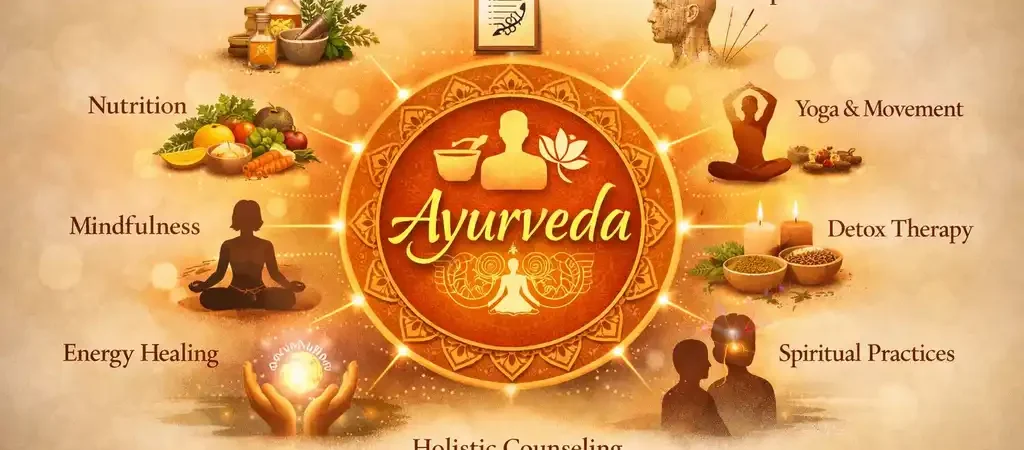
Holistic Medicine for Beginners: Beyond the Buzzwords
Holistic medicine is one of those terms people hear often — but rarely understand fully. For most, it simply means “natural” or “non-Western.” But in truth, it’s a broad umbrella that includes many systems and practices aimed at treating the whole person — not just the disease.
People interested in holistic health today often explore:
Herbalism—using plants and plant extracts for healing
Naturopathy — supporting the body’s healing with supplements, detox, and natural therapies
Chiropractic or acupuncture — working with structural or energetic alignment
Functional medicine — running deep lab tests to find root causes of illness
Lifestyle coaching — improving sleep, stress, diet, and movement
And while these all aim to support balance and healing, many of them treat health in fragments. One practitioner might focus on food, another on stress, another on the liver. The result? A lot of puzzle pieces — but no map.
That’s where Ayurveda changes the conversation.
Ayurveda: A Complete System for True Holistic Healing
If you’re beginning your journey into holistic health, Ayurveda gives you something most modern systems don’t: a unifying framework that connects everything.
Here’s what makes it uniquely powerful:
✅ It’s Personal
Ayurveda begins with your body type (dosha) — not symptoms. You’re not a “case” or a condition. You’re a specific combination of elements, tendencies, and patterns. Every food, herb, and routine is matched to you.
✅ It’s Patient-Centered and Root-Cause Oriented
Before healing anything, Ayurveda looks at digestion and metabolism (agni). If these aren’t working, nothing else will. The system tracks how imbalance builds before disease shows up.
✅ It’s Truly Holistic: Body, Mind, and Spirit
Mental clarity, emotions, sleep, focus, and even spiritual wellbeing are core parts of Ayurvedic healing. It doesn’t separate mind from body. Instead, it connects them through subtle energies like chakras, marma points, and nadis.
✅ It Includes Detox and Rejuvenation Therapies
Ayurveda teaches that toxins (ama) block health. Through therapies like Panchakarma, food resets, and lifestyle corrections, the body clears what’s no longer useful — and builds strength.
✅ It Builds Immunity, Vitality, and Longevity
Rather than just fixing problems, Ayurveda’s goal is resilience. That means stronger digestion, deeper sleep, emotional stability, and long-term energy. Healing isn’t just recovery — it’s optimization.
If you’re just starting out, this is the message:
Holistic medicine isn’t limited to supplements and symptom-tracking.
There’s a time-tested, complete approach that’s already done the work of integration for you — it’s called Ayurveda.
Whether you’re seeking personal transformation or considering a path toward holistic health practitioner training, understanding Ayurveda gives you a foundation that no patchwork system can replicate.
Ready to go deeper? Let’s look at how you can begin your own journey as a beginner — with clarity, not chaos.
How to Become a Holistic Medicine Practitioner
The path to becoming a holistic medicine practitioner depends heavily on your background. Are you already a licensed medical provider? Or are you entering from a non-clinical, wellness-oriented direction?
Both routes are valid — but they require different strategies.
For Medical Professionals: Adding Holistic Tools to Modern Medicine
If you’re an MD, DO, NP, PA, nurse, chiropractor, dentist, or hold another clinical credential, your route to holistic practice is typically supportive, not substitutive. That means you’re not replacing medicine — you’re personalizing it with integrative tools.
Here’s how many clinicians expand their scope into holistic medicine:
Studying herbal medicine for non-pharmaceutical support
Understanding functional supplementation without interference
Learning nutrition for healing, not just maintenance
Adding stress, sleep, and lifestyle protocols
Adjusting treatment by individual constitution, not just diagnosis
Why Ayurveda Is the Perfect Partner for Medical Professionals
Ayurveda doesn’t try to compete with Western medicine — it complements it.
It gives practitioners powerful insights that modern tools miss, including:
Body type-based personalization (Vata, Pitta, Kapha)
Root-cause frameworks (digestion, agni, ama)
Gentle, whole-herb supplementation, which doesn’t interfere with prescriptions the way extracts can
Example: Heart patients on calcium channel blockers should avoid unregulated calcium supplements — but can benefit from mineral-rich foods and herbs matched to their constitution.Seasonal and cyclical detoxification therapies to reduce systemic burden
A way to optimize resilience and vitality, not just manage illness
For clinicians, Ayurveda provides a language of balance, not just biomarkers — and a method to help patients bridge lifestyle with treatment in an intelligent, non-invasive way.
For Non-Clinicians: Becoming a Holistic Practitioner Without a Medical Degree
If you don’t hold a medical license but want to practice holistic medicine, your role will likely be that of a:
Holistic wellness coach
Health consultant
Herbal educator
Lifestyle advisor
Mind-body practitioner
These roles allow you to guide, educate, and support clients — not diagnose or treat disease directly.
Many aspiring practitioners start by studying disciplines like:
Herbalism
Nutrition
Acupuncture or energy work
Yoga or meditation
Lifestyle coaching
But here’s the challenge: Without a framework, each tool feels separate. That’s why so many non-clinical practitioners get stuck.
Why Ayurveda Is the Missing Framework for Non-Medical Practitioners
No matter what modality you study, Ayurveda makes it smarter.
Example 1: Herbalism
Most herbalists are taught in terms of chemical properties — “turmeric is anti-inflammatory because of curcumin.”
But Ayurveda asks:
What’s the person’s body type?
Is inflammation due to heat, dryness, or heaviness?
Will turmeric’s heating quality aggravate the person further?
What should it be combined with?
What’s the right dose, timing, and form?
Without this level of precision, herbalism becomes guesswork.
Example 2: Acupuncture or TCM
Practitioners of acupuncture work with energetic points and meridians — but often miss the macropoints defined in Ayurveda’s marma system.
There are 108 marma points — critical energetic junctions that govern not just energy flow, but organs, tissues, and psychological function.
Marma = macro
Acupuncture = micro
Without marma knowledge, a practitioner might stimulate a minor point and miss the central cause of imbalance.
Example 3: Lifestyle Coaching
Many health coaches recommend sleep hacks, supplements, or productivity routines — but miss the deeper rhythms that Ayurveda teaches.
Ayurveda includes:
Dinacharya (daily routine)
Seasonal adjustment
Mindful transitions for stress and mood
Food-timing rules for better sleep and energy
Spiritual and subtle practices to ground the mind
You might give someone a sleep remedy… but without fixing digestive timing, screen exposure, or breath rhythm, it won’t work.
Holistic Doesn’t Mean Scattered — It Means Integrated
Most modern practitioners (clinical or not) end up using multiple systems without one true framework. That creates overlap, contradiction, and client confusion.
Ayurveda solves that.
It connects food, energy, psychology, detox, and even spirituality — all through a body-type-based lens that has stood the test of time.
Holistic Therapist Training: Why Start at the Root Instead of the Branches
If you search for holistic therapist training today, you’ll find dozens of paths — each representing a different branch of natural health.
Some courses focus on energy healing like Reiki. Others are centered around somatic therapies, nervous system regulation, or mind-body coaching. A few are grounded in talk-based emotional counseling that leans spiritual rather than clinical. You’ll also find training in:
Mindfulness-based stress reduction (MBSR)
Emotional freedom techniques (EFT/tapping)
Breathwork certification programs
Integrative nutrition and lifestyle coaching
Trauma-informed wellness practices
These are all valuable. But they are all fragmented.
To pursue each as its own specialization means signing up for multiple certifications, learning parallel (sometimes conflicting) theories, and constantly trying to “stitch it all together.” Most holistic therapist training pathways unintentionally become a patchwork of tools — each helpful, but none fully integrated.
This is the reality: The more you study holistic care in parts, the more incomplete it can feel.
The Smarter Alternative: One Root System With All the Branches
Ayurveda solves this fragmentation.
Rather than learning holistic therapy through 5–7 separate courses, Ayurveda offers one integrated system where everything connects:
Herbalism becomes contextualized: not just what herbs do, but who they are right for, based on constitution and imbalance.
Nutrition is personalized, not just generalized. It’s not about “anti-inflammatory foods” — it’s about food energetics matched to body and mind types.
Mindfulness & emotional healing are embedded within daily routines and practices for self-awareness, clarity, and balance.
Movement & breath aren’t arbitrary — they’re tailored to the individual’s current imbalance (too much fire? too little air?).
Spiritual growth is a legitimate path, with food, sleep, energy, and conduct aligned for higher consciousness.
Energetic therapies like chakra balancing and marma point activation have structured foundations, not just symbolic associations.
Instead of learning about food in one course, energy in another, emotions in a third, and spiritual practices in yet another — you learn one holistic map. And it’s all connected.
From Patchwork to Wholeness: Ayurveda as Holistic Therapist Training
If your goal is to practice truly holistic therapy — not just diet, not just lifestyle, not just energy work, not just spiritual counseling, but all of it, together — then Ayurveda is the most efficient, complete, and time-tested way to begin.
It’s not just a shortcut. It’s the origin.
Because Ayurveda isn’t just one path of healing. It’s the entire landscape that other paths branch out from.
So if you’re seeking holistic therapist training that doesn’t leave you constantly trying to integrate scattered teachings — start with the system that was designed to hold it all.
Ayurveda.

 Google