
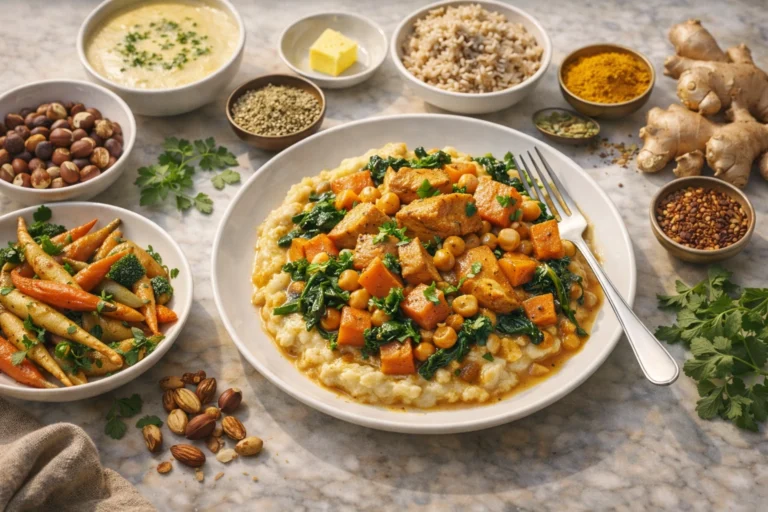
Feeling scattered, dry, bloated, gassy, or like your energy comes in unpredictable waves? If so, choosing the right foods for Vata dosha can make meals feel more grounding—less “snack chaos,” more steady fuel.
Vata is the dosha of movement. When it’s high, your body often responds best to foods that are warm, cooked, moist, and nourishing. This guide gives you a practical Vata foods list by category (vegetables, fruits, proteins, dairy, grains & legumes, nuts & seeds, oils, spices)—with “best choices,” “okay sometimes,” and “limit,” plus how much to aim for.
How to use this foods for Vata Dosha List
Keep it simple:
Best (most days): your go-to Vata-balancing foods
Okay sometimes: rotate in a few times per week
Limit (occasionally): not “bad,” just more likely to dry you out, cool you down, or make digestion unpredictable
One more rule that changes everything for Vata:
Cooked beats raw most of the time—especially in windy, cold, dry seasons or when you already feel “off.”
Before you copy this Foods for Vata Dosha list… read this
This article is written for people searching “foods for Vata dosha,” but here’s the nuance that changes everything: most people are not purely Vata. You’re typically a combination (Vata-Pitta or Vata-Kapha), and your current state can be very different from your birth constitution.
Example: you might be born Vata-Pitta, but right now be running a strong Vata imbalance from stress, travel, irregular meals, or poor sleep. In that case, even “healthy” foods can land differently.
So treat these recommendations as a Vata balancing foods list but not your personal list or plan.
To check your own birth and current body type (or dosha), take the Ayurveda dosha test.
Foods for Vata Dosha require specific tastes (Ayurvedic rasa)
In Ayurveda, tastes have effects. For Vata, think: grounding, moistening, settling.
Favor (most often):
Sweet (think: rice, oats, milk, root veggies—not just sugar)
Sour (a little: citrus, yogurt, fermented foods if tolerated)
Salty (moderate: mineral salt, broths)
Go easy on (especially when Vata is high):
Bitter (too much can feel drying/cooling)
Pungent (very spicy can overstimulate)
Astringent (drying—raw veggies, popcorn, many crackers)
If this feels abstract, here’s the shortcut:
Vata usually does best with food that feels like comfort + moisture + warmth.
Vata balancing foods: Vegetables
Foods for Vata dosha always start with vegetables. They are many varieties to choose from, each with it’s own quality. Vegetables are also the easiest to digest and most require cooking (not eaten raw), which gives Vata the warmth it requires, plus, allows the use of spices to balance the Vata dosha.
Best (most days):
Root vegetables: sweet potato, carrot, beets
Squash: butternut, acorn, pumpkin
Zucchini, asparagus, green beans
Leafy greens cooked (sautéed or simmered)
Okay sometimes:
Broccoli, cauliflower, cabbage (better cooked, with spices)
Peppers (if they don’t irritate you)
Limit (especially raw):
Large raw salads as a daily lunch
Very dry/crunchy veggie habits (raw kale, big bowls of raw crucifers)
How much:
Aim for 1–2 cups cooked vegetables per meal. If you do raw, keep it smaller and pair it with warm soup or warm tea.
Vata balancing foods: Fruits
Foods for Vata dosha list must include fruits, especially, the ones that are juicy, moist, sweet, and substantive (heavier). But, try stewing to take them warm, and not cold. Or at the least, room temperature, not from refrigerator.
Best (most days):
Ripe, juicy fruits: mango, peaches, berries (as tolerated)
Apples/pears stewed (a Vata classic)
Bananas (if they feel good for you)
Okay sometimes:
Grapes, melons (better at room temp, not ice-cold)
Limit:
Very dry fruits in large amounts (like too many dried snacks)
Too much fruit late at night (can disrupt some people)
How much:
1–2 servings/day is a sweet spot for many.
If digestion is sensitive, have fruit between meals or as part of breakfast—not right after a heavy dinner.
Vata balancing foods: Proteins (plant + animal)
Vata often needs protein that’s easy to digest, not dry or overly processed.
Best (most days):
Eggs
Tofu/tempeh
Well-cooked lentils and mung dal
Soups/stews with protein
Okay sometimes:
Chickpeas/beans (better soaked, cooked well, spiced)
Fish and poultry (often easiest when moist: soups, braises)
Limit:
Very dry proteins (jerky, dry grilled chicken with no sauce)
Lots of protein bars as meals (often dry + stimulating)
How much:
Aim for a palm-sized portion per meal (or ¾–1 cup beans/lentils).
If you feel lightheaded or snacky, you probably need more protein and/or fats—not less.
Vata balancing foods: Dairy
Dairy can be very grounding for Vata if you tolerate it.
Best (most days, if tolerated):
Warm milk (or warm milk alternatives) with spices
Ghee
Yogurt in small amounts (better midday than night)
Okay sometimes:
Soft cheeses in moderation
Limit:
Ice cream and cold dairy at night
Too much cheese if it makes you feel heavy or congested
How much:
Small portions go far for Vata. If dairy causes mucus/heaviness, reduce and lean on oils, soups, and warm cooked foods instead.
Vata balancing foods: Grains & legumes
Grains are often a Vata superpower—when cooked well.
Best (most days):
Oats
Rice (especially well-cooked)
Quinoa (cooked soft)
Cream of rice / porridges
Okay sometimes:
Barley (can be drying for some—watch how you feel)
Whole wheat (if it digests well)
Limit:
Dry crunchy cereal as a meal
Dry crackers as “lunch”
How much:
Vata often does well with ½–1 cup cooked grain per meal, especially at lunch and dinner, when paired with vegetables + protein + fat.
Vata balancing foods: Nuts & seeds
Nuts and seeds belong in the foods for Vata dosha list. They are great for grounding, but choose the ones that feel nourishing, not drying. Soaking is the best way to convert the dryness to moist and nourishing.
Best (most days):
Almonds (soaked if possible)
Sesame (tahini is great)
Chia/flax (soaked into pudding or oatmeal)
Okay sometimes:
Walnuts, cashews (watch heaviness)
Limit:
Huge handfuls of dry nuts as a “meal replacement”
Very roasted/salted nuts in excess (can dehydrate you)
How much:
A small handful (or 1–2 tablespoons seeds) is usually enough.
Vata balancing foods: Oils & fats
Foods for Vata dosha includes fats. Fats & oils are often what make Vata feel “safe” in the body. Fats & oils “absorb” the excess Air element in the Vata dosha.
Best (most days):
Ghee
Olive oil
Sesame oil (especially in colder months)
Avocado
Okay sometimes:
Coconut oil (can feel cooling—see how you respond)
Limit:
Very low-fat eating as a long-term default (often destabilizing for Vata)
How much:
Add 1–2 tablespoons of healthy fat per meal (oil, ghee, avocado, tahini). If your meals feel “dry,” add fat first.
Vata balancing foods: Spices & herbs
Vata likes spices that are warming and digestively supportive, not scorching.
Best (most days):
Ginger
Cumin
Coriander
Fennel
Cinnamon
Cardamom
Turmeric
Okay sometimes:
Black pepper (moderate)
Limit:
Very hot chili/cayenne-heavy meals if they make you feel wired or irritated
How much:
Use spices daily, especially in soups and cooked grains—Vata often digests better with a little warmth and aroma.
Vata portion & frequency guide (not restrictive)
Instead of strict rules, use this rhythm:
3 meals/day at consistent times (often better than grazing)
Warm breakfast if you tend to feel anxious, shaky, or snacky
Lunch as the main meal when possible
Early, simple dinner to reduce nighttime restlessness
If you only do one thing:
Make lunch warm, cooked, and complete (veg + protein + grain + fat).
You might consider the Vata diet article for a more controlled Vata meal plan.
Build a Vata-friendly plate (quick formula)
When you don’t know what to eat, use this:
Cooked vegetables (1–2 cups)
Cooked grain (½–1 cup)
Protein (palm-sized or ¾–1 cup legumes)
Healthy fat (1–2 tablespoons)
Gentle warming spices
If it looks like a warm bowl or stew, you’re usually on the right track.
If you’re searching for Vata foods, chances are you want clarity fast. But here’s the truth: most people aren’t just Vata.
Not sure if you’re “really” Vata?
You’re usually a blend (Vata-Pitta or Vata-Kapha), and a proper plan needs to account for both:
- your birth constitution (prakriti) — your baseline blueprint
- your current imbalance (vikriti) — what’s happening right now based on stress, sleep, digestion, season, routine, and lifestyle
That’s why two people can both identify as “Vata” and still need very different foods, portions, and meal timing.
If you want a plan that actually fits your body (not just the generic list):
👉 Start the Vata Dosha Management Course (for the full Vata-specific system)
or
👉 Download the Ayurveda App to get the diet built in and use AI Chef to generate recipes tailored to your constitution + current imbalance.
Conclusion: Creating Stability Through Vata-Friendly Eating
A Vata-friendly approach to food restores calm, predictability, and nourishment. Through intentional Vata foods and thoughtful vata cooking, digestion strengthens, anxiety softens, and energy becomes steady rather than scattered.
Ayurveda does not aim to control the body. It teaches how to listen, respond, and support it intelligently. When food aligns with Vata’s needs, balance becomes a daily experience rather than a constant pursuit.
References
Govindaraj, P., Nizamuddin, S., Sharath, A., et al. (2015).
Genome-wide analysis correlates Ayurvedic Prakriti types with genetic variations.
Scientific Reports, 5, 15786.Peterson, C. T., Lucas, J., John-Williams, L. S., et al. (2017).
Identification of altered metabolomic profiles associated with Ayurvedic constitutional types.
Journal of Ayurveda and Integrative Medicine, 8(3), 159–165.Mills, P. J., Peterson, C. T., Wilson, K. L., et al. (2018).
Relationships among classifications of Ayurvedic medicine and modern psychological measures.
Journal of Ayurveda and Integrative Medicine, 9(4), 245–251.Rotti, H., Mallya, S., Kabekkodu, S. P., et al. (2014).
DNA methylation analysis of phenotype-specific Prakriti types.
Journal of Translational Medicine, 12, 147.Sharma, R. K., & Dash, B. (2014).
Charaka Samhita: Text with English Translation and Critical Exposition. Chowkhamba Sanskrit Series, Varanasi, India.

 Google